
Emissions reduction targets - what about the products I buy?
Many people look to corporates to take the lead on reducing greenhouse gas (GHG) emissions. But how can I tell how ambitious they are without trawling through their websites for information?
For many years most companies set fairly arbitrary targets of X% emissions reduction for some time in the future. These weren’t grounded in much logic other than how ambitious each company thought it could/ should be.
Things have become much more robust over the last few years with the adoption of ‘Science Based Targets’ or SBTs.
What ‘Science’?
Climate scientists generally agree that the worst effects of a changing climate would be achieved by limiting global temperature increase to below 1.5°C or well below 2°C compared to pre-industrial levels.
Governments and businesses therefore need to reduce GHG emissions to limit increasing temperatures.
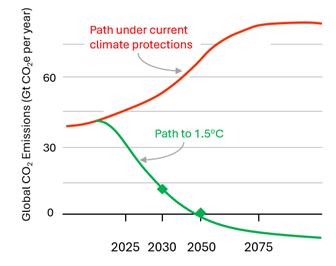
The red line on the image shows the trajectory of global GHG emissions assuming that all commitments by governments around the world are delivered. You’ll see emissions continuing to increase.
The green line illustrates the GHG emissions reduction pathway required to keep global temperature increase below 1.5°C.
A Science Based Target (SBT) is a GHG emissions reduction target that aligns with the level of decarbonisation required to keep global temperature increase below 1.5°C i.e. the green line.
Targets are set ‘near term’ (typically for 2030) and long term (typically 2050). Long term SBTs are sometimes referred to as ‘net zero’ targets but this can be perceived by some as being a politically charged expression.
Targets are set for companies’ direct emissions from their own operations such as factories or retail premises (often referred to as Scope 1&2) as well as ‘indirect’ emissions from their upstream and downstream supply chains (referred to as Scope 3 emissions).
For most food and drink businesses emissions from supply chains (such as sourcing agricultural commodities and from consumption e.g. refrigeration and cooking) are often around 10 times greater than direct emissions from factories or shops.
So how can I tell what targets companies have committed to?
A company can only claim to have a Science Based Target if it has been validated by the Science Based Targets Initiative (SBTi).
SBTi consider what a company does and ensures that greenhouse gas reduction targets are consistent with limiting global warming to below 1.5°C.
Targets are required to be set for both ‘direct’ (Scope 1&2) and ‘indirect’ (Scope 3) emissions.
So far over 10,000 companies around the world have set SBTs.
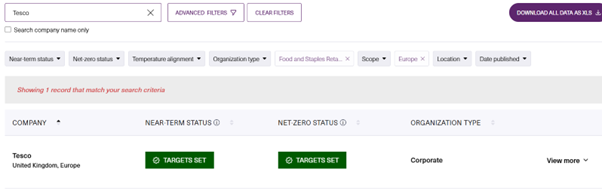
You can see each company’s targets via SBTi’s website via this link Target dashboard - Science Based Targets Initiative
An example is shown below for a popular UK retailer. The drop down arrow on the right hand side allows you to read the details.
A couple of words to help find and understand the information …
Targets are set at parent company level so you sometimes have to know which parent owns the UK company or brand, and
For food and drink companies you may see reference to FLAG targets. These relate to Forest Land And Agriculture and are a particular subset of targets relevant to agricultural commodities